A newsletter about work, change, and finding your way in a world that won’t show you the map. Issues on careers, leadership, AI, remote work, team-building, work trends -- served to your inbox each week.
Share
#186 - Turn To Page 29
Published about 2 months ago • 5 min read
#186 - Turn To Page 29
The limits of my language mean the limits of my world. — Ludwig Wittgenstein
For years, as a kid on Long Island, New York, I had two groups of friends: school buddies I saw during the day, and two brothers, Bobby and Santí, who I hung out with after class.
Bobby and Santí's mom was from Spain and they went to a nearby Catholic school, but they were my default afterschool option; right across the street, always around, always fun. Play on demand.
When I turned nine though, these friends moved to Spain -- and left a gaping hole in my wild suburban social life of bikes, baseball and Transformers.
Santí is bottom row, second from left, pouting; I'm second from right.
Lucky for me, a new family soon moved in around the corner. Luckier still, they had three kids: Ethan, slightly older, Chris, my age, and a younger sister, Marley. Just like that, I had a knock-on-the-door, "Can they come out and play?" option again.
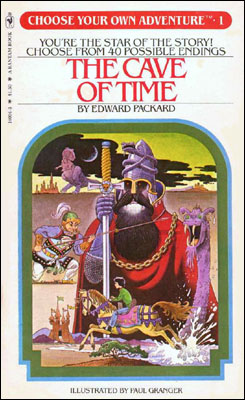
I remember the Packards' dad being a quiet, sort of patrician doctor. Much more exciting -- insanely so, to 9-year-old me -- was that he had a brother named Edward. Edward as in Edward Packard the author of the Choose Your Own Adventure book series I was obsessed with.
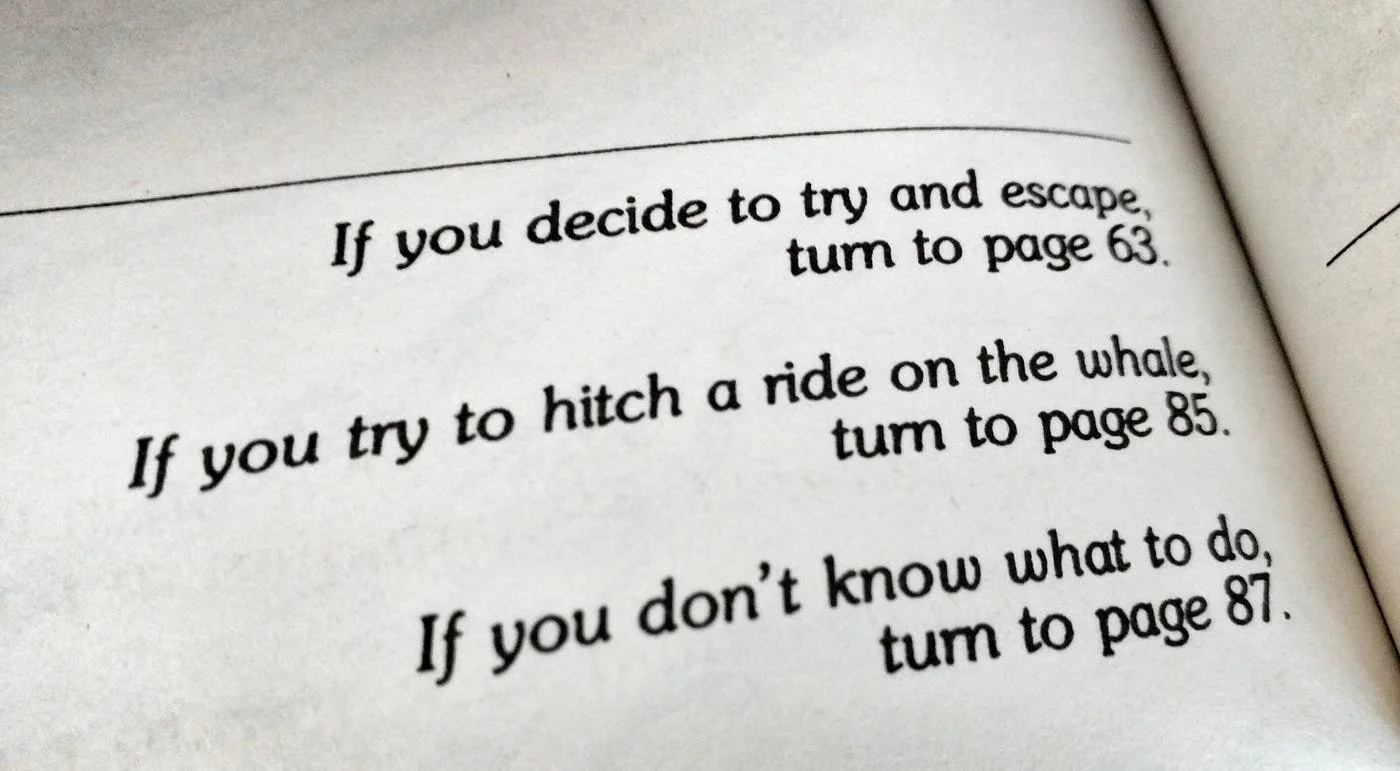
The idea of Choose Your Own Adventure was simple: you read a bit into the book, then decided what the hero should do. Choose option A, and go to page X. But choose option B, and go to page Y instead. Read more, make another decision, flip to a different page; and so on.
The books were a smash hit in the 80s. I don't know if it was having a say in the story, as a reader, or the quality of the writing; probably both. But Edward Packard couldn't write the next book fast enough for me.
Choose Your Own Adventure!
A new career game needs new language
Most of us are playing a game that no longer exists. — Dror Poleg
I've been writing about the death of the predictable, linear career ladder. Last week, I even called the ladder a "fiction" -- comforting, but obsolete.
Once you let that ladder go, though, you're left with something more open-ended, uncertain and unpredictable. You're playing a new game. And if you don’t understand its dynamics, its constraints, and its rewards -- you can't thrive at it.
Language is how you learn the new rules. And by changing the words we use to describe our careers, we change our ability to navigate them.
Many of us still use old vocabulary that limits us. We use words like "risk" when we can say "bet," or "taking a detour" when we mean "trust our intuition."
We need new language to navigate the career world that’s actually here. This week is about that language. It's about reframing uncertainty so we can engage with it, not avoid it. About the vocabulary we need to choose our own adventures.
Three branches: choosing my adventures
Looking back, my life and career haven't been a ladder, but a series of branching paths. Each move -- personal, professional, physical -- was a "turn to page X" moment where the story could have gone in different ways. Where my decision influenced not just future choices and outcomes, but who I became. Here are three of them.
Spain: turn to page 11 - I cried when Bobby and Santí moved away to Spain. But two years later, when I was 11, I got to visit them in Madrid for six weeks -- on my own.
I remember being part excited, and part terrified. My folks packed me up with three dozen New York bagels, dropped me at JFK, and put me on the plane as an unaccompanied minor.
Six weeks of adapting. Church every Sunday. Eating paella and gazpacho. Playing soccer in Spanish. Quick "I miss you" phone calls every other week; quick because they cost three dollars a minute.
I still remember my crocodile tears when I found my parents and sister in arrivals.
Soccer camp + short shorts in Madrid. Santí, on the right.
Guatemala: turn to page 28 - In 2004, I ducked out of the corporate world to volunteer with a French NGO, Doctors Without Borders, in Guatemala. It meant crossing into the world of medical non-profits; learning accounting; learning Spanish; learning to decode my Guatemalan and French colleagues.
I took over from a Frenchman named Pierre -- rebranded as 'Pedro', of course -- who'd spent the past year in the role. He trained me in debits and credits, Guatemalan slang, how to work with a difficult boss, and how to discern good will from danger in a country emerging from a brutal civil war.
Hard work, long hours, challenging context.
TalentStories: Turn to page 44 - Most recently, I left a string of corporate jobs to start TalentStories. When I did, I entered a new world again: online, creative, entrepreneurial.
I've been building a brand, a community and a portfolio of services. I'm still toiling away. But now I get to help steer others through similar transitions. 🙌🏻
The reframes I wish I'd had
I can appreciate now that these moments weren’t about "courage." They were encounters with uncertainty that I managed (or mismanaged). What changed over time was my ability to recognize a branch in my path and confront it with better awareness, confidence -- and language.
Here's how I’ve come to update my own dictionary:
Risk ➡️ Bet: Spain felt risky at 11. Guatemala felt risky in my twenties. TalentStories still feels risky. But they were actually unfamiliar environments with constraints and challenges; upsides and learnings. "Risk" frames them as something to avoid. "Bet" frames them as a choice with potential upside.
Fear ➡️ Curiosity: Fear is a constant, but it’s a poor navigator. I’ve found that leaning into curiosity -- asking questions, exploring, screwing up, learning -- can help turn my fear from a roadblock into more of a compass. 🧭 Hard things ➡️ Confidence Builders: The challenges that defined these experiences were formative. Loneliness. Steep curves. Ambiguity. Demanding contexts. But they weren't just hard, they were forced adaptations. And over time, coming out the other side of healthy bets has bred confidence.
Going alone ➡️ Having Guides: I went to Spain by myself. I went to Guatemala by myself. I'm a solopreneur. But none of these experiences meant flying solo. My folks nudged me towards Madrid, and my friends took care of me there. In Guatemala, Pedro handed over his role and his context. I started TalentStories thanks to my friend, Usman Sheikh, who generously introduced me to the stories, tools and people waiting in an unstructured, entrepreneurial world. 🙏
Stepping Off The Path ➡️ Trusting Intuition: Leaving the path you're on always feels reckless. But it depends on what you’re stepping toward. For me, healthy bets are about alignment: betting on a new path not because you know what awaits you -- but because you question what you know awaits on the one you're on.
What gets rewarded in the adventure world
This vocabulary doesn’t kill uncertainty, and it doesn't guarantee the "Good Ending" on page 112, either. But it does allow us to embrace our career reality as an active choice.
To navigate it, I’ve started tracking an evolving list of values that can help steer without a map:
Curiosity over fear.
Movement over stagnation.
Learning over complacency.
Connection over going alone.
Adaptation over repetition.
Smart bets over risk avoidance.
This list should read less as advice and more as a description of what works in the new game. As a set of levers that create momentum and temper the uncertainty we face.
This week was about the language of the game. Next week, we’ll look at tactics: how to build "career capital" and create leverage when you're living in a portfolio world.
Thanks for reading and exploring with me -- and have a great end of the week! 🙏
Aki
If you enjoyed this, forward it on to a friend.
Someone forwarded it to you? Sign up here for every issue.
A newsletter about work, change, and finding your way in a world that won’t show you the map. Issues on careers, leadership, AI, remote work, team-building, work trends -- served to your inbox each week.
#194 - You Can't Take It With You When opportunity comes, it's too late to prepare. — John Wooden I always wonder about people who sign up for newsletters with a work email. Not the standard Gmail, or an old school Hotmail address. Not a hip firstname@yourname.com. But a good, old-fashioned @currentemployer.com. I mean, I get it: we're at work all the time, and we're in our inboxes all day. And these are newsletters we're talking about, not cures for cancer. But as time passes, I think about...
#193 - Nobody Saw It Happen What you do speaks so loudly, I cannot hear what you say. — Ralph Waldo Emerson A close friend, I'll call her Molly, built a tremendous career in public service. For over 20 years, she lived and worked around the world doing aid work for the US government. But last year, along with tens of thousands of others, she got caught in the grind of Elon Musk's DOGE cuts. Her job was gone, but so was the entire path she'd followed, and had planned to follow into retirement....
#192 - What Changed In You If you dislike change, you’re going to dislike irrelevance even more. — General Eric Shinseki Two days into my first job as a recruiter, I sat on a big, open floor of connected desks, with phones buzzing nonstop. One of the partners at the firm came up to me, unprompted. He’d moved from New York to open the San Francisco office, and is probably the person I learned more about recruiting from than anyone. Without greeting or segue, he launched in: Aki, if you really...